Łódź once built its reputation on textiles and factories; another industry later gave the city a different identity, this time through the moving image.
There is a particular reason why the Museum of Cinematography belongs in Łódź. The city is closely associated with Polish film, from the internationally recognised Łódź Film School to generations of directors, cinematographers, actors and animators who studied or worked here. Its industrial streets and distinctive architecture have also provided a visual backdrop for countless productions.
The Museum of Cinematography brings that history together, preserving the objects, techniques, people and stories that helped establish Łódź as one of Poland's most important film centres.
Established in 1986, the museum grew from a collection that had been assembled over the previous decade. Its staff began collecting film-related objects between 1977 and 1985, including materials from the Film School, posters, cinema programmes, photographs and production memorabilia.
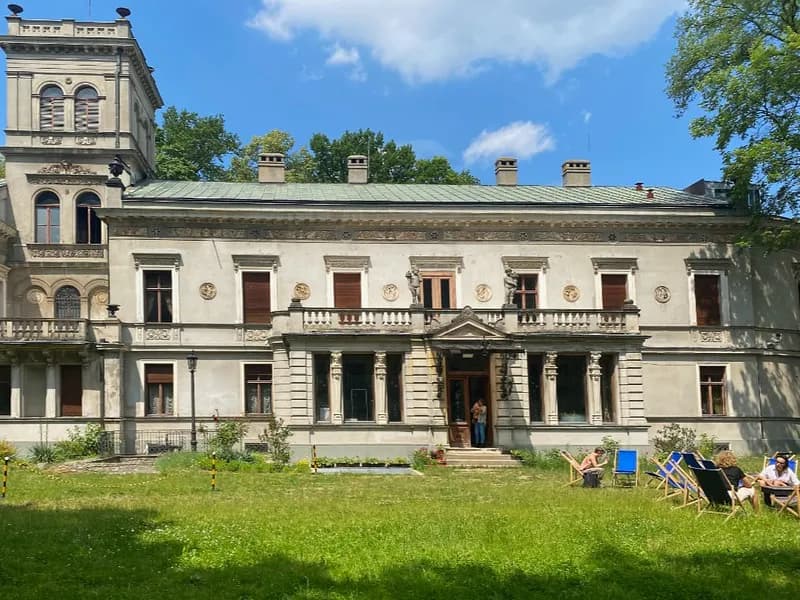
The collection eventually found its permanent home in the historic Scheibler Palace at Plac Zwycięstwa.
From industrial city to film capital
Cinema may seem a world away from the textile factories that transformed Łódź during the 19th century, yet the two histories are closely connected.
The industrial expansion created a city of distinctive factories, workers' housing, palaces and broad streets. That built environment later became part of Łódź's visual identity and helped provide the settings in which filmmakers could tell stories about Poland's changing society.
After the Second World War, Łódź became particularly important to the development of Polish cinema. The establishment and growth of major film institutions, most notably the Łódź Film School, created a concentration of creative talent that would influence Polish cinema for decades.
The museum's "Film Łódź" permanent exhibition explores this development.
Visitors encounter the early history of moving images alongside the institutions and individuals that helped establish the city's cinematic reputation. Cameras, set designs, photographs and other film materials demonstrate not only how films were made, but how the technology and creative practices behind them evolved.
The exhibition also looks further back, introducing visitors to 19th-century optical devices that helped create the foundations of cinema.
Among them are a stereoscope, a mutoscope and a large historic photoplasticon. The latter has its own connection with Polish film, having appeared in Juliusz Machulski's 1981 film Vabank.
The museum also holds a surviving fragment of The Promised Land, a 1927 film based on Władysław Reymont's novel about the industrial development of Łódź.
That connection is particularly fitting. A city whose fortunes were once built on factories and textile production later became the setting and subject of films that preserved something of that industrial world on screen.
The people and institutions behind the screen
The museum's collection is not simply about famous films. It also documents the organisations and creative communities that made Łódź such an important part of Polish cinema.
The Łódź Feature Film Studio, Se-Ma-For Small Film Studio and Łódź Film School all feature in the permanent exhibition, providing a wider picture of the city's film infrastructure.
Together, they reveal how cinema developed as a creative ecosystem rather than through individual productions alone.
For visitors unfamiliar with Polish film history, this is particularly useful. The museum provides a route through a complicated cultural story, showing how education, production, technology and artistic experimentation combined to give Łódź its reputation.
And then there is animation.
A palace full of animated memories
The museum's second permanent exhibition, "Palace Full of Fairy Tales", turns its attention to Polish animation.
Here, the history of animation becomes tangible through original puppets, animation materials and characters that have been familiar to several generations of Polish viewers.
Visitors encounter Teddy Bear Uszatek, Colargol, the Moomins, Bolek and Lolek, Reksio and Florka, alongside objects showing how animated productions were created.
For children, the exhibition offers an accessible introduction to animation. For adults, it can also be a journey into television memories from earlier decades.
Interactive elements, including an animation table, help explain the techniques behind the finished characters. The exhibition therefore moves beyond nostalgia and shows the craftsmanship involved in producing animated films.
That educational element is central to the museum's wider purpose.
The institution is not simply preserving old cameras or famous characters. It explains how moving images are created, how the technology developed and why particular films and institutions became important to Polish cultural history.
The museum's significance has continued to evolve. Renovation work carried out between 2019 and 2021 introduced improvements designed to make the institution more accessible while also reshaping elements of the permanent exhibition.
Today, the Museum of Cinematography offers a way of understanding Łódź through one of the city's most distinctive cultural achievements.
The story begins with optical experiments and early cinema, passes through the city's film institutions and studios, and reaches the animation characters remembered by generations of viewers.
In that sense, the museum does more than preserve Polish cinema. It helps explain why cinema became such an important part of Łódź itself.
The city changed dramatically over the 20th century, but its relationship with film became one of the threads connecting its industrial past with its cultural present. Inside the Museum of Cinematography, that story can still be followed, one camera, character and frame at a time.
Visitor Information
Museum of Cinematography in Łódź
Plac Zwycięstwa 1, Łódź
Opening hours
Monday: Closed
Tuesday: Closed
Wednesday–Friday: 09:00–16:00
Saturday–Sunday: 11:00–18:00
Admission
Standard: PLN 28
Reduced: PLN 18
Children under 7: Free admission