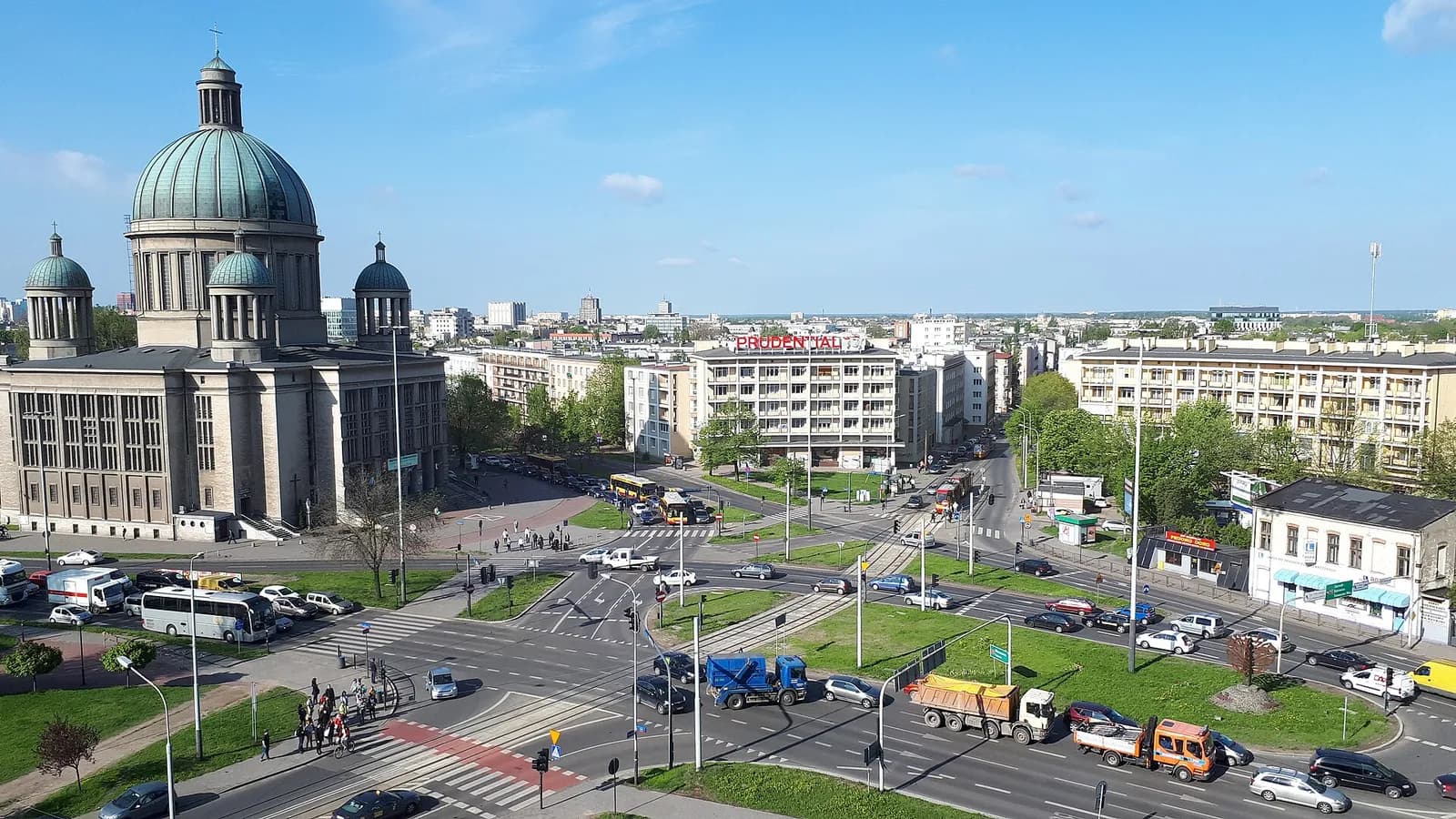
Łódź has come out on top in an analysis looking at one of the most practical measures of urban greenery: how close trees and larger green areas are to people’s homes.
The city ranked first for the proximity of larger concentrations of greenery, putting it ahead of Katowice, Warsaw and Kraków. The analysis was prepared by the blog Kartografia Ekstremalna using, among other sources, data from the European Union’s Copernicus programme.
It offers a slightly different way of looking at what makes a city green. Rather than simply counting the number of hectares covered by parks and forests, it asks a more everyday question: how far does someone actually have to go to find trees?
For Łódź, the answer is often: not very far.
Greenery is woven into Łódź
Trees are not confined to the city’s best-known parks.
They line residential streets, appear between blocks of flats, fill courtyards and soften some of Łódź’s busiest neighbourhoods. Even in built-up parts of the city, patches of greenery can often be found within a short walk.
That proximity is particularly significant in a city as large and densely developed as Łódź. A park several kilometres away may look impressive on a map, but trees outside the front door have a much more immediate role in everyday life.
The analysis looked at how many people live close to concentrations of trees, including areas within around 30 metres of their homes. On this measure, Łódź performed exceptionally well.
The underlying greenery and population data date from 2021, so the results should be read as a snapshot rather than a live measurement of the city in 2026. They nevertheless provide an interesting picture of how Łódź’s urban landscape was distributed.
Las Łagiewnicki gives Łódź an unusual advantage
One of the city’s defining green assets is Las Łagiewnicki, a vast woodland within the administrative boundaries of Łódź.
For a major Polish city, having such an extensive forest within its boundaries is notable. Residents can reach woodland paths for walking, cycling and recreation without having to leave Łódź.
The forest is only one part of the picture, however. The city also has a network of parks, squares, tree-lined streets and recreational areas spread across its neighbourhoods.
Together, these spaces create a pattern of greenery that is much harder to capture by simply comparing the total area of parks or forests.
It is not simply about counting hectares
The same analysis illustrates why different rankings can produce very different ideas of which Polish cities are the greenest.
In a separate personal ranking by the author, combining different approaches to measuring access to greenery and trees, Łódź placed third, behind Katowice and Zielona Góra. Olsztyn and Kraków were among the cities ranked below it.
There is no contradiction between the two results. They measure different things.
A city can have a large amount of forest or parkland without those areas being particularly close to where most people live. Conversely, a city with extensive tree cover spread throughout its neighbourhoods can offer residents much easier everyday access to greenery.
That distinction puts Łódź in an interesting position.
A city where the trees are close by
Łódź is sometimes associated primarily with its industrial heritage, nineteenth-century architecture and rapidly changing city centre. Its green character is less obvious when the city is described through those familiar themes.
Look a little closer, though, and the trees are difficult to miss.
They are part of the residential landscape, stand alongside roads and tram routes, appear in courtyards and connect larger green spaces across the city. The result is that access to nature does not always require a trip to one of Łódź’s major parks.
That is what makes the new analysis particularly interesting. It does not suggest that Łódź simply has more green space than every other Polish city. Instead, it highlights the closeness of greenery to where people live.
And for anyone walking through Łódź, that is a distinction that can be felt rather than simply measured on a map.
See more: Łódź ZOO Orientarium: Discovering the Wildlife of South East Asia
Source: kartografia-ekstremalna, lodz.pl