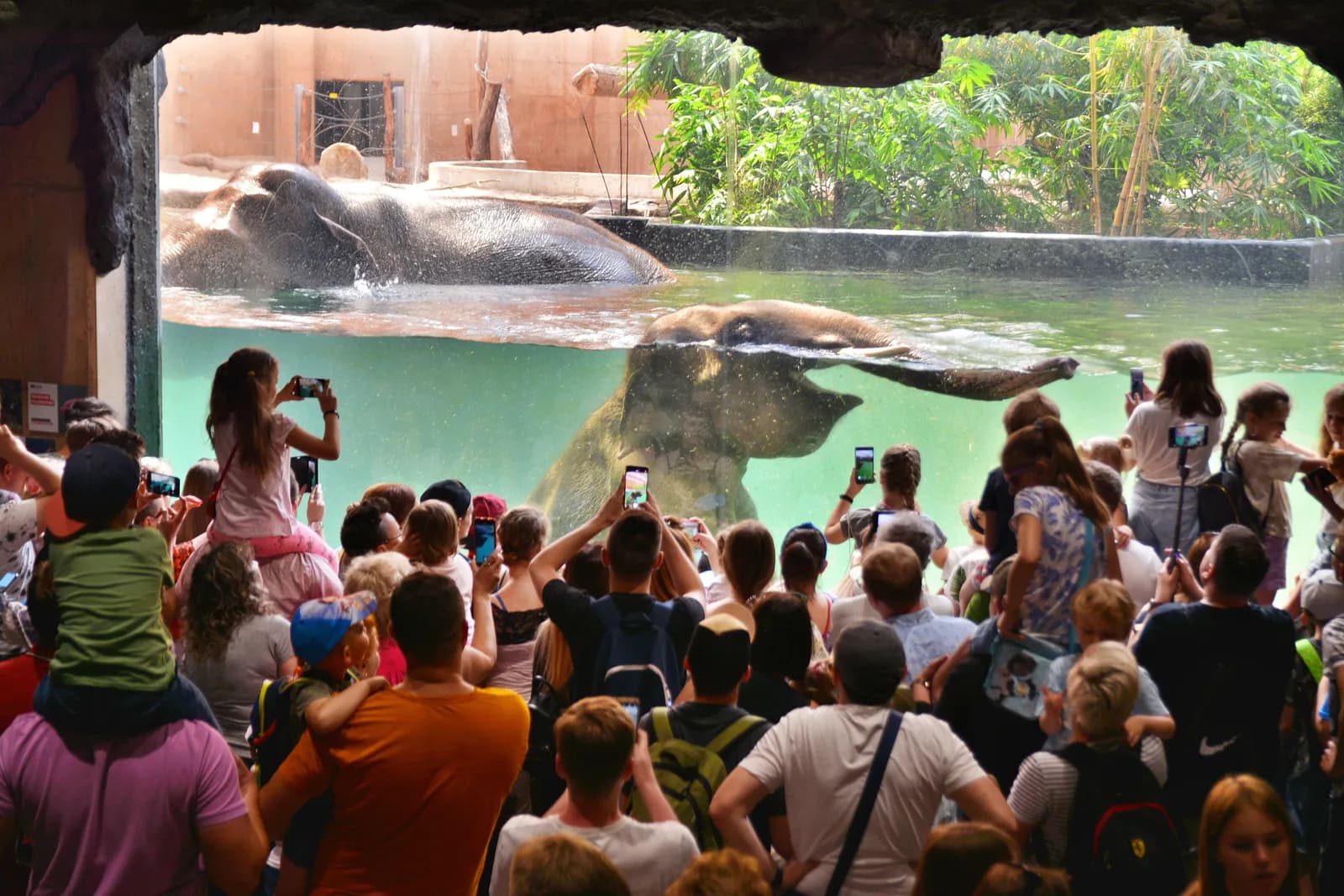
Underwater, among tropical vegetation or looking upwards into free flight, the Orientarium offers several ways to encounter South East Asian wildlife.
A visit to Łódź ZOO's Orientarium is designed around more than simply seeing animals. The pavilion brings together fauna and flora from South East Asia across an extensive environment of enclosures, aviaries and aquatic habitats, allowing visitors to observe its inhabitants from underwater, from land and from above.
The building and its enclosures cover an area equivalent to almost ten football pitches. Within them are 35 species of land animals and 180 species of fish, with many animals sharing large, varied environments with other species.
The result is a setting where the scale and diversity of South East Asian wildlife become central to the experience.
The elephants give the Orientarium its largest presence
The Indian Zone is home to the Orientarium's elephants, with a 2,000-square-metre enclosure and a pool. Outside, weather permitting, the animals have access to three sections, two pools and waterfalls, alongside smaller hoofed mammals with their own sanctuary.
At the centre of this group is Alexander, the first animal to arrive at the Orientarium. The 45-year-old elephant came to Łódź from Münster Zoo in Germany. Weighing more than six tonnes and standing just over 3.5 metres at the withers, he is described as the largest and oldest representative of his species in Europe.
Alexander is also distinctive for having only one tusk.
He is currently accompanied by Taru, Kyan and Barnaba, aged 11, 12 and 13 respectively. The longer-term plan is to build a herd of eight to ten elephants, with females expected to join the group in the future.
The elephant area is only one part of the Orientarium's broader story. Throughout the pavilion, the emphasis is also on species whose future is considerably less secure.
Beneath the surface, another world unfolds
One of the most striking ways to explore the Orientarium is through its 26-metre underwater tunnel. Seven ocean tanks contain more than three million litres of water and are home to more than 1,300 animals representing 180 species.
Among them are the only guitarfish in Poland, zebra sharks and stingrays whose tails extend beyond one and a half metres.
The different levels of the aquariums reveal different parts of underwater life, from fish moving through deeper water to species remaining close to the bottom. In the coral reef tank, visitors can also see blue tangs, bluespotted stingrays, wrasses, fusiliers and other reef fish.
The aquatic environments offer a reminder that the Orientarium is not only about large and immediately recognisable animals. Its inhabitants range from substantial marine species to animals whose movements and behaviour become visible only when visitors stop and observe carefully.
That sense of immersion continues in the Sundaic Islands zone, the warmest part of the pavilion. Temperatures remain between 24 and 26 degrees Celsius with humidity approaching 80 per cent, creating conditions that resemble a tropical environment.
Here, the endangered wildlife becomes particularly important. The Orientarium is home to Sumatran orangutans, including Ketawa, Budi and Joko. The species is endemic to northwestern Sumatra and has declined by approximately 80 per cent in recent decades.
Nearby are gavial crocodiles Kraken and Penelope. Kraken measures 5.15 metres, making the pair the largest members of their species in Europe. In the wild, gavials face threats including hunting and the loss of their natural habitat.
A glimpse of a disappearing natural world
Conservation is not confined to the largest animals. The Orientarium also houses critically endangered species including sun bears, Javan langurs, binturongs and gibbons.
In the Celebes section, wanderoo macaques live in an enclosure inspired by a Buddhist temple. Łódź ZOO has kept and bred this rare species for 35 years. In the wild, only around 2,500 to 3,000 individuals remain, with hunting and tropical deforestation among the threats facing them.
Their neighbours are Asian small-clawed otters, the world's smallest otters, while Malayan tapirs can also be seen in the same area.
Above visitors' heads, the experience changes again. Bali mynas, cattle egrets, king quails, pink-headed imperial pigeons, bulbuls, Luzon bleeding-hearts and crested partridges are among the birds found in the Orientarium. Some move freely through the free-flight area, bringing another dimension to the experience.
Other inhabitants are considerably harder to spot. Java mouse-deers are small, secretive mammals measuring around half a metre and weighing up to two kilograms. Specially prepared terraria meanwhile contain South East Asian invertebrates, including golden silk orb-weavers, Indian ornamental tree spiders, emperor scorpions and stick insects.
Outside the pavilion, the wider zoo continues the journey with species including Visayan warty pigs, golden jackals, sacred langurs, Japanese macaques, Abyssinian ground hornbills and griffon vultures.
What connects these very different animals is the opportunity to encounter them within environments designed around their lives rather than simply as isolated exhibits. From the elephants' outdoor landscape to the underwater tunnel and free-flight birds, the Orientarium offers several perspectives on a region whose wildlife includes both familiar species and animals facing serious threats.
That variety is ultimately what gives the Orientarium its character. It is not one view of South East Asia, but many: above the visitor, beneath the water, across the land and within the increasingly important conversation about how these species can survive.
Visitor Information
Tickets
Regular: 90 PLN
Reduced: 65 PLN
Orientarium opening hours
9:00 am–7:00 pm
Last entry: 6:00 pm